Disseminating Knowledge
Welcome to my publications page. Here you will find links to my academic papers and reports, spanning various topics within econometrics and related fields. Explore my research contributions and feel free to delve into the details of each publication.
Unveiling the future: predicting unforeseen natural environmental disasters in the Mediterranean and Balkan areas in the face of climate change
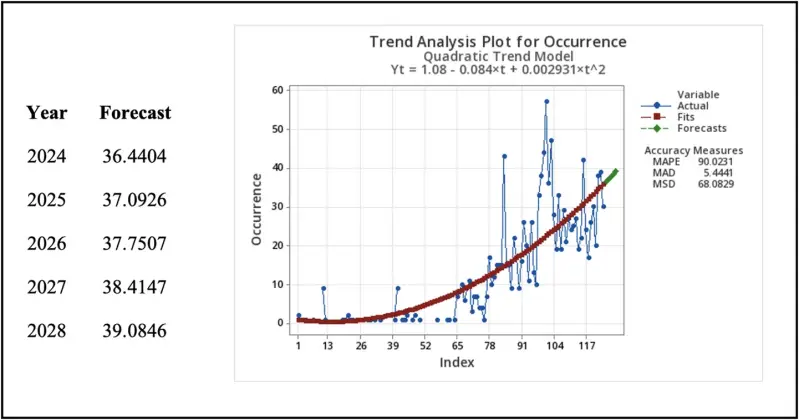
In recent years, there has been a worrying increase in the frequency and intensity of unexpected natural disasters, including floods, wildfires, earthquakes, and severe storms. Trend analysis reveals a troubling connection between climate change and the increasing occurrence of these calamities, with areas once considered relatively safe now facing increased vulnerability. Specifically, regions such as Western Europe have experienced extreme rainfall, while the Mediterranean has seen intensified droughts, both of which have disrupted local economies and created serious public safety risks. Meteorological forecasts indicate that these trends will persist, with the severity of these disasters expected to increase. The purpose is to identify statistically significant trends across various hazard categories—meteorological, climatological, hydrological, and geophysical—and to provide short-term forecasts aimed at supporting regional disaster risk reduction and policy planning. Using data from the EM-DAT database spanning several decades, we applied linear, quadratic, and exponential trend models to analyze past behavior and generate five-year projections (2024–2028). As a result, it is essential for policymakers and communities to prioritize effective disaster preparedness and promote sustainable practices to reduce future impacts. Our initial analysis compares past decades with the current, more challenging decade, as well as contrasts different global regions. Furthermore, trend analysis highlights the severity of the ongoing climate crisis in terms of both occurrence and loss. Our aim is to provide evidence-based insight into natural disaster dynamics in the Mediterranean and the Balkan regions, by analyzing historical trends and forecasting short-term future patterns in disaster occurrences, fatalities and economic losses. Understanding these trends not only helps forecasting but also underscores the urgent need for collective action to address the underlying factors driving this escalating crisis. Our findings reveal a statistically significant increase in the frequency and economic losses of meteorological and climatological hazards, while geophysical hazards show no consistent trend. These results highlight the growing relevance of climate-sensitive risks and the urgent need for targeted adaptation strategies across vulnerable regions.

From Lignite to Low-Carbon: Greece's Journey in the Climate Change Performance Index (CCPI)
Monitoring national climate performance is fundamental for translating the Paris Agreement’s global objectives into actionable national policy. This study examines Greece’s progress through the lens of the Climate Change Performance Index (CCPI), an internationally recognized tool assessing mitigation efforts across four pillars: Greenhouse Gas (GHG) Emissions, Renewable Energy, Energy Use, and Climate Policy. Drawing on data from CCPI
(2006–2025), IPCC assessments, and national policy documents, the analysis situates Greece’s climate trajectory within the broader frameworks of the Intergovernmental Panel on Climate Change (IPCC) and the United Nations Sustainable Development Goals (SDGs). Results indicate that Greece’s CCPI ranking improved from 35th in 2018 to 22nd in 2025, reflecting significant advances in renewable energy deployment and energy efficiency, yet persistent weaknesses in policy implementation and governance capacity. The country’s emissions have declined by approximately 38% since 2005, driven by a rapid lignite phase-out and expansion of solar and wind power. However, gaps remain in transport, buildings, and industrial decarbonization, limiting full alignment with a 1.5°C-compatible pathway. The findings highlight the interplay between technical progress and institutional performance, showing that Greece’s transition is constrained less by technological potential than by fragmented governance, delayed enforcement, and uneven adaptation capacity. Strengthening policy coherence, sectoral accountability, and just transition mechanisms is therefore essential for sustaining CCPI improvements and achieving IPCC- and SDG-consistent outcomes. The study concludes that integrating CCPI metrics into national climate governance can enhance transparency, accelerate policy delivery, and position Greece as a regional model for integrated climate action in the Eastern Mediterranean.
Environmental Performance in Transition: An Empirical Examination of Greece through the EPI Framework
The Environmental Performance Index (EPI) is a widely recognized tool developed by Yale University and Columbia University, in partnership with the World Economic Forum, to assess countries' environmental performance using 58 performance indicators across 11 issue categories. The EPI provides a comprehensive benchmark for evaluating environmental health, ecosystem vitality and climate change. Greece, as a member of the European Union (EU), operates within a complex regulatory framework aimed at promoting sustainable development. Greece's performance in the EPI reflects both its environmental policy efforts and its exposure to regional challenges such as air pollution, biodiversity loss, and climate-related risks. In recent years, Greece has demonstrated progress in areas such as renewable energy development and climate change mitigation, although issues like waste management and air quality continue to require focused policy intervention. Analyzing Greece’s EPI score offers valuable insights into its environmental priorities and the effectiveness of national strategies aimed at promoting
sustainability and resilience.


Valuation of Marine Ecosystem Services in the Black Sea
The Black Sea region faces pressures on ecosystem services (ES) due to invasive species, waste, eutrophication, and biodiversity loss. We apply a stated preference technique, i.e. a choice experiment (CE), aiming to compare three hypothetical scenarios regarding the welfare impact of ES on citizens’ lives in terms of willingness-to-pay (WTP). Initially, the distributed questionnaires underwent an econometric pre-test regarding the orthogonality of all CE scenarios in R-studio. Questionnaire distribution occurred from 29/05/2023 to 21/11/2023 with a total number of 375 responders from the three pilot sites: Turkey, Romania, and Georgia. The highest WTP occurred in Turkey (56.72€) for all scenarios followed by Georgia (49.04€), and Romania (47.96€). Moreover, the greater WTP value is demonstrated by Scenario C (25.51€) followed by Scenarios B (25.17€) and Scenario A (25.11€). Interesting socioeconomic characteristics derived from Cross-Tabulation Analysis that notably cannot impact the WTP are income, gender, and age. Furthermore, marital status and education might affect the WTP only in Romania, however, this is not demonstrated in Turkey or Georgia. Interestingly, the higher level of education in Romania is linked to lower WTP, nevertheless, education typically relates to environmental sensitivity. Another aspect is that occupation can change responders’ WTP in Romania and Georgia, but not in Turkey. In essence, the economic valuation of ES through CE methodology can offer policymaking insights into Blue Growth initiatives.
The Effects of Climate Change to Weather-Related Environmental Hazards: Interlinkages of Economic Factors and Climate Risk
Climate change has become an increasingly intense global phenomenon in recent years. A great number of researchers support the idea that climate change is strongly connected to some environmental hazards, and specifically, those correlated to extreme weather events. Following the Paris Agreement, and due to the increased concern regarding climate change impacts, several indices have been established. The Climate Change Performance Index (CCPI) includes 59 countries and the EU, which cumulatively emit 92% of global greenhouse gases (GHGs), while the Global Climate Risk Index (CRI) analyzes to what extend countries have been affected by impacts of weather-related loss events. Both indices provide annual scores to each country and rank them based on those scores indicating the existing environmental situation. Our main purpose is to examine whether there is an interconnection between those two indices as well as testify whether economic growth is a great contributor to country’s environmental performance and as a result to climate risk. Using a sample of the reported countries for the year 2019, the latest reported year for both indices, and following a cross-sectional econometric analysis, we provide evidence regarding the connection of CCPI and CRI by using graphs, mapping visualization and econometric estimations in order to draw lines between indices. Moreover, we examine the interlinkages, and we estimate the influence caused by socio-economic factors and emissions levels per country. We provide evidence regarding the high-ranked and low-ranked countries and how they perform not only to an environmental base, but also to an economic base. Regarding the major finding, based on our analysis, no proven causality between CRI and CCPI was observed. Economic growth appears to have a significant impact on CRI but not on the CCPI, for the year 2019, while population density has an impact on both indices. Regarding greenhouse gas emissions, the econometric estimations provide evidence of significance for CRI but not for CCPI. An in-depth understanding of the current situation as well as of the factors affecting the climate conditions will give us the needed elements in order to minimize the adverse impact, if not improve the current situation. It is well known and stated that climate action should be taken so that we bequeath a safer and more sustainable planet to the next generations.
